When sourcing realistic artificial trees, buyers need clear quality checks before placing a bulk order. A physical sample can reveal important details such as leaf texture, trunk finish, color variation, canopy fullness, base stability, and assembly quality. Buyers should also confirm that the approved sample will be used as the standard for mass production, with agreed tolerances for color, dimensions, materials, and packaging.
This guide explains how to evaluate artificial tree quality, inspect a supplier sample, and reduce the risk of quality differences between the approved sample and the final shipment.
Key takeaways
- Score realism on six physical attributes: leaf texture, trunk, colour layering, canopy fullness, base, сборка.
- The real risk is sample-to-bulk drift, not the sample itself—lock tolerance in writing.
- Ask what inspection the supplier can arrange (SGS/CE reports on request), not what they claim to hold.
- Entry terms we run: mixed first order from 20 pieces, bulk MOQ 100, standard 15-45 day lead time.
- Full-chain in-house control is the practical defence against batch colour drift.
What Makes an Artificial Tree Look Realistic?
The realism of an artificial tree depends on how closely its appearance and structure resemble those of a natural tree. Rather than relying on a single feature, buyers should evaluate several details together, including foliage design, color variation, trunk texture, branch arrangement, and overall proportions.
A realistic artificial tree typically has the following characteristics:
- Natural leaf appearance: Leaves have appropriate shapes, sizes, цвета, and surface textures for the selected tree species.
- Subtle color variation: Different shades of green and natural-looking color transitions prevent the foliage from appearing flat or overly uniform.
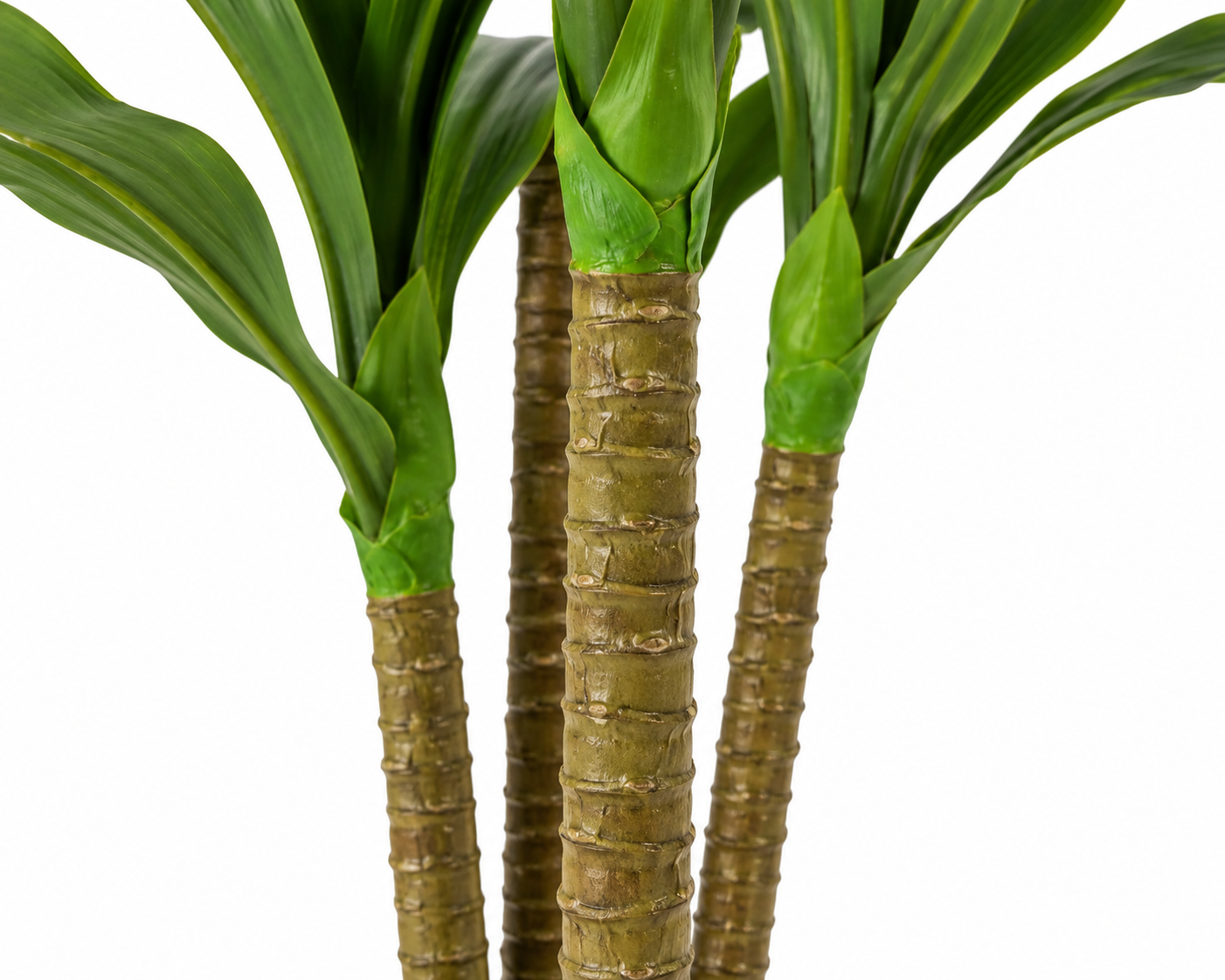
- Detailed trunk finishing: The trunk has visible textures, natural-looking patterns, or other surface details that resemble real bark.
- Balanced branch arrangement: Branches extend in different directions and positions instead of forming an overly symmetrical structure.
- Appropriate foliage density: Leaves are distributed naturally, creating a full appearance without making the tree look unnaturally crowded.
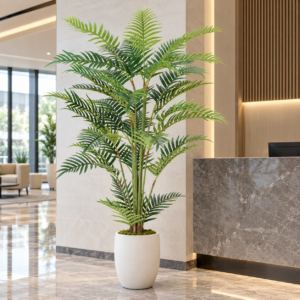
The intended application also influences how buyers should evaluate realism. For example, artificial olive trees used in residential interiors may require detailed leaf shapes and slender branches, while artificial areca palms for hotels or commercial spaces need a convincing overall silhouette and well-arranged foliage.
Buyers should therefore evaluate artificial trees according to both their intended tree species and the environment in which they will be displayed.
How to Inspect Artificial Tree Leaves, Trunks and Branches
A closer inspection of individual components helps buyers identify differences that may not be obvious in standard product photographs. Leaves, стволы, and branches should be evaluated separately before considering the overall appearance.
Leaf Shape, Color and Texture
Leaves usually occupy the largest visible area of an artificial tree, making their appearance particularly important.
Start by comparing the artificial foliage with photographs of the corresponding natural tree species. Pay attention to leaf proportions, edges, vein patterns, and the way individual leaves are arranged along each branch.
Several details deserve attention:
- Shape and size: Leaves should reflect the characteristic appearance of the selected species rather than using generic shapes across different tree varieties.
- Color variation: Natural foliage often contains multiple shades of green. Slight differences between individual leaves can create a more convincing appearance.
- Surface texture: Check whether the leaf surface has appropriate details and whether its finish looks excessively glossy under normal lighting.
- Thickness and flexibility: Leaves should have a suitable thickness and flexibility for their design, without appearing excessively thin or rigid.
- Edge finishing: Inspect the edges for rough cuts, uneven molding, or visible manufacturing defects.
Buyers should also examine the foliage from different angles. Some artificial leaves may look convincing from the front but reveal unnatural shapes, flat surfaces, or inconsistent colors when viewed from the side or back.
Trunk Surface and Branch Structure
The trunk and branches provide the structural foundation of an artificial tree. Their appearance and construction influence both realism and product stability.
For the trunk, check whether the surface resembles the natural texture of the corresponding tree species. Depending on the product design, this may include bark-like patterns, color variations, surface grooves, or molded details.
For the branch structure, consider the following:
- Whether branches have natural-looking thickness and curvature.
- Whether branch connections are neatly finished.
- Whether the internal support allows branches to be adjusted when required.
- Whether branches maintain their intended positions after shaping.
- Whether the trunk-to-branch connections appear secure.
A particularly important detail is the transition between the trunk and branches. Poorly finished connection points can make an artificial tree look manufactured rather than natural.
For larger artificial trees, buyers should also check the relationship between the trunk, internal support, and base. These components need to work together to support the product’s overall structure.
Overall Shape and Foliage Density
Even when individual leaves and branches look convincing, the complete tree may still appear artificial if its proportions are incorrect.
Step back and evaluate the tree as a complete product. Consider its height, canopy width, branch distribution, and foliage density.
A natural-looking artificial tree should have a balanced silhouette that reflects the growth characteristics of its species. Some trees naturally have dense, rounded canopies, while others have more open branches and irregular growth patterns.
Foliage density also deserves attention because it affects both product appearance and manufacturing costs. Insufficient foliage may leave too much of the internal structure visible, while excessive foliage can make the tree look crowded and increase material usage.
For wholesale buyers, it is useful to confirm the expected canopy width and foliage arrangement rather than evaluating product quality based on height alone.
What Materials Should Buyers Check in Artificial Trees?
Material selection affects the appearance, flexibility, structural performance, and overall cost of artificial trees.
Two products with similar designs may use different materials and manufacturing methods, resulting in noticeable differences in their finished appearance. Buyers should therefore request a clear material breakdown before comparing supplier quotations.
PE Leaves and Their Appearance
Polyethylene (PE) is a commonly used material for molded artificial foliage. It allows manufacturers to produce leaves with different shapes, surface details, and textures.
When evaluating PE artificial tree leaves, buyers should consider:
- Molding details: Check whether the leaf shape, edges, and vein patterns are clearly formed.
- Surface finish: Examine whether the finish looks natural under different lighting conditions.
- Color consistency: Check whether the color matches the approved product design and whether there are noticeable differences between leaves.
- Гибкость: Evaluate whether the leaves have suitable flexibility for their intended design.
- Manufacturing quality: Look for uneven molding, visible defects, or poorly finished edges.
PE is not automatically an indicator of premium quality. The final appearance also depends on material formulation, mold design, coloring techniques, and production workmanship.
Buyers should also distinguish between PE foliage and other materials, such as PVC or fabric-based leaves. Each material has different characteristics, and the most suitable option depends on the product design, target market, and budget.
If a supplier offers multiple material options, request samples to compare their appearance and feel before making a purchasing decision.
Steel Structures and Internal Support
The internal structure is another important consideration, particularly for taller artificial trees or products with larger canopies.
Steel components may be used in the internal support system to help maintain the trunk or branch structure. Their dimensions, positioning, and connection methods should be appropriate for the product’s size and design.
Buyers should confirm:
- Whether steel or other support materials are used.
- How the internal structure connects to the trunk and branches.
- Whether the support can maintain the intended tree shape.
- Whether the base connection is secure.
- Whether the complete structure remains stable after assembly.
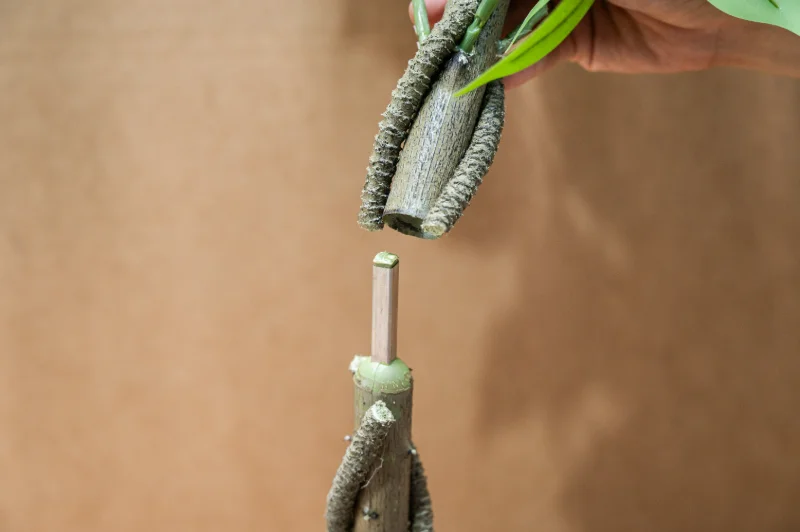
For products supplied in knock-down (KD) packaging, buyers should also check the connection design and assembly process. The individual sections should fit together properly without creating noticeable gaps or excessive movement.
It is important to evaluate the internal structure according to the actual product specifications. A tabletop artificial plant and a large decorative tree have different structural requirements, so the same support configuration should not be assumed for every product.
How to Check Artificial Tree Quality Through Samples
Product photographs and specifications are useful for initial supplier comparisons, but they cannot fully demonstrate material quality or construction details.
Requesting a physical sample is one of the most practical ways to evaluate an artificial tree before committing to a larger order. It allows buyers to examine the actual product, compare its appearance with their expectations, and identify potential issues before mass production.
Comparing Product Photos with Physical Samples
Start by comparing the received sample with the supplier’s original product photographs and specifications.
Check whether the actual product matches the agreed design in terms of:
- Overall height and canopy width.
- Leaf shape, color, and surface finish.
- Trunk appearance and branch arrangement.
- Foliage density and overall proportions.
- Pot style, dimensions, and finishing details, if included.
Do not rely exclusively on photographs taken in a showroom or under professional lighting. Examine the sample under natural daylight and ordinary indoor lighting to see whether the foliage has an unnatural shine or noticeable color differences.
It is also helpful to photograph the sample from the front, sides, back, and close-up angles. These records make it easier to compare different suppliers and communicate any required adjustments.
For buyers sourcing multiple artificial tree varieties, evaluate each model separately. A satisfactory olive tree sample does not automatically establish the quality of a different product with another leaf design or construction method.
Checking Leaf Attachment and Structural Stability
After evaluating the appearance, inspect how the individual components are assembled.
Gently handle the branches and foliage to check whether the connections feel secure. Look for loose leaves, poorly attached branches, visible adhesive marks, or uneven finishing.
For trees with adjustable branches, reposition them carefully to see whether they can maintain their intended shape.
The trunk and base also need attention. Check whether the tree stands properly after assembly and whether the base connection shows excessive movement.
For KD products, assemble the sample according to the supplier’s instructions and examine the connections between individual sections.
A practical sample inspection checklist includes:
| Attribute | Pass signal | Fail signal |
|---|---|---|
| Leaf texture | Veined, matte, tone variation | Flat, glossy, identical leaves |
| Trunk | Texture and natural taper | Smooth moulded tube, visible seam |
| Colour | Within agreed batch range | Noticeable drift vs approved sample |
| Canopy | Full, slightly irregular | Sparse or mirror-symmetrical |
| Base | Holds stated height, no wobble | Tips, rocks, undersized pot |
Once the sample meets the required standards, buyers should retain it as a reference for subsequent production and quality comparisons.
How to Ensure Consistent Quality in Bulk Orders
Approving a sample is an important purchasing step, but maintaining the same quality throughout mass production requires additional preparation.
Differences in materials, сборка, плотность листвы, and finishing can affect the consistency of artificial trees across a large order. Buyers should establish clear product requirements with the manufacturer before production begins.
Confirming Product Specifications Before Production
A product name or reference photograph alone may not provide enough information for accurate mass production.
Before confirming an order, prepare a detailed specification sheet covering the key characteristics of each artificial tree model.
Important information includes:
- Product dimensions: Confirm the total height, canopy width, trunk dimensions, and pot size where applicable.
- Material specifications: Identify the materials used for leaves, филиалы, стволы, and internal support structures.
- Color requirements: Confirm the approved foliage colors and any specific color variations.
- Structural details: Specify the branch arrangement, internal support, and assembly requirements.
- Foliage density: Establish the expected fullness and overall appearance.
- Packaging requirements: Confirm whether products will be supplied fully assembled or in KD packaging, along with carton specifications.
For customized products, buyers should also confirm the details of private labeling, pot selection, and packaging design before production.
These specifications should be documented in the purchase order or an agreed product confirmation document. This gives both parties a common reference and helps reduce misunderstandings during manufacturing.
Checking Samples Against Mass Production
The approved sample should serve as the reference standard for the bulk order.
Before mass production is completed, buyers can request production photos or videos to review the product’s appearance and manufacturing progress. This is particularly useful for customized orders or products with specific foliage and structural requirements.
When conducting a bulk inspection, compare selected finished products with the approved sample.
Focus on the following areas:
- Appearance consistency: Check whether leaf shapes, цвета, and foliage density remain consistent with the approved sample.
- Dimensional accuracy: Verify that product height, canopy width, and other agreed measurements meet the specifications.
- Assembly quality: Inspect branch connections, leaf attachment, trunk finishing, and base construction.
- Packaging consistency: Confirm that the packaging method and product protection match the agreed requirements.
For larger orders, buyers may also arrange third-party inspections based on their own quality requirements and inspection criteria.
It is important to agree on the inspection method before production rather than waiting until the goods are ready for shipment. Clear standards help manufacturers understand what buyers expect and give both parties a practical basis for evaluating the finished products.
Looking for a Reliable Artificial Tree Manufacturer? Meet Grand Green
Choosing an artificial tree manufacturer involves more than comparing product photographs and quotations. Buyers need a supplier that understands product appearance, material selection, manufacturing requirements, and the importance of consistency across bulk orders.
Гранд Грин, operated by Dongguan Grand Green Crafts Co., Ltd., is a Chinese artificial plant manufacturer specializing in the development, производство, and export of artificial greenery. Основан в 2018, the company serves customers in more than 40 countries and regions, offering artificial trees and plants for wholesale, розничная торговля, and decorative applications. Its product range includes artificial olive trees, арековые пальмы, dracaena trees, ficus trees, and fiddle leaf fig trees, covering different decorative styles and customer requirements.
Grand Green supports OEM and ODM services, including customization of:
- Tree dimensions and overall appearance.
- Foliage colors and product details.
- Pot styles and sizes.
- Private labeling and packaging.
With an in-house production operation, Grand Green develops more than 40 new products each quarter and has a monthly production capacity of approximately 50,000 pieces, with peak-season capacity reaching around 80,000 pieces.
For buyers developing new product collections or expanding existing artificial greenery ranges, the company also offers flexible ordering arrangements. First orders can start at approximately 20 pieces, with mixed orders available. Standard bulk orders typically start at around 100 pieces, depending on the product and requirements.
Whether you are sourcing artificial olive trees for retail distribution or developing customized artificial greenery for your own brand, working with a manufacturer that understands both product design and production requirements can make the sourcing process more straightforward.
Contact Grand Green to discuss your artificial tree requirements, request product samples, and explore OEM/ODM cooperation opportunities.
Часто задаваемые вопросы
How do I tell a realistic artificial tree from a cheap one?
Check leaf veining and matte finish, trunk taper and joints, colour layering across leaves, canopy fullness, base stability and how firmly modular parts seat. Glossy, uniform leaves and a moulded tube trunk are the fastest tells.
Should I order a sample before a bulk order?
Always. The sample is how you set the benchmark; the real risk is whether the container matches it. Approve physical leaf, trunk and base samples, then lock the acceptable tolerance in writing.
What MOQ and lead time should I expect?
At Grand Green a mixed first order starts from 20 pieces and bulk orders from a 100-piece MOQ, against a standard 15-45 day lead time. Many peers set a 300-piece floor.
Can the supplier provide quality test reports?
Ask what they can arrange rather than what they claim to hold. We can support SGS/CE inspection reports on request and cooperate with audits, but we do not state certifications we have not passed.
Why does sample-to-bulk consistency matter so much?
Colour batches, leaf moulds and trunk finishes drift between runs. A factory that makes its own moulds and assembles in-house controls that drift; a trading company usually cannot, which is where dead stock comes from.
Compare Tree Suppliers On Verifiable Facts
Browse the range, request a sample set for the species you are stocking, and hold every supplier to the same six-point checklist.
Explore Artificial Trees →