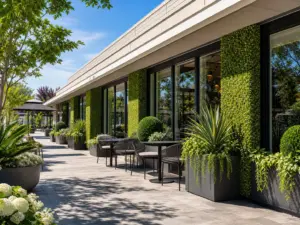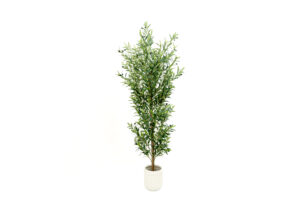
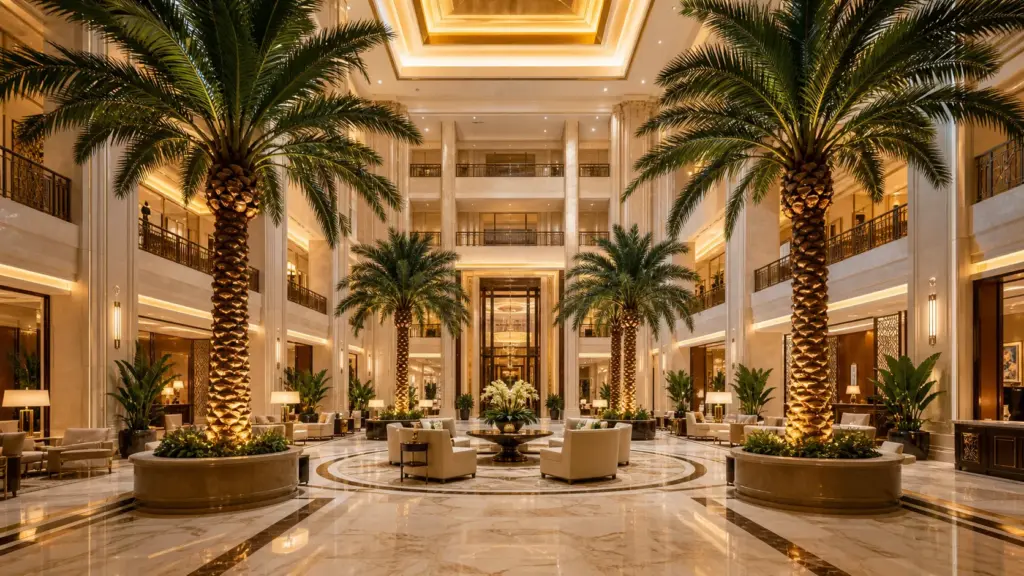
Specifying artificial indoor trees for a commercial interior is a sourcing exercise, not a decorating one. Офисы, hotels and malls need floor-standing trees that read correctly under professional lighting, arrive on schedule, survive daily abuse, and can be reordered consistently across sites. This guide is written for the buyer who has to defend that selection—species, size, MOQ and lead time—rather than pick a favourite from a catalogue.
Grand Green is a product supplier: we handle sizing and specification advice, but we do not provide commercial-space design, staging or on-site installation. State that boundary up front because it is where most interior projects go wrong—plan so a local installer or facilities team handles placement, and let the supply chain do what it can actually control.
The difference between an interior that still reads well in year three and one quietly swapped out is almost never the first impression. It is whether the supplier behind the trees can hold the same form, height and colour when you reorder for the next floor. That is why this guide treats species, sizing, fire documentation and reorder terms as one connected sourcing problem rather than four separate choices.
Key takeaways
- Commercial projects fail on scale more often than on realism—lock height, footprint and lighting first.
- Areca palm, dracaena/dragon tree and olive/fig silhouettes cover most interior styles.
- Specify to size: OEM/ODM on dimensions, colour and planter beats forcing a catalogue height.
- Entry terms: mixed first order from 20 pieces, bulk MOQ 100, standard 15-45 day lead time.
- Tall floor-standing trees ship as KD flat-pack—3 modules, 5-10 minute clip assembly.
Start With The Space Not The Catalog
Interiors fail on scale more often than on realism. Before you look at a single product, lock three parameters, because each one eliminates species and sizes for you:
- Ceiling clearance and placement. A lobby tree and a reception-corner tree need very different heights. Note true available height, not the nominal ceiling.
- Footprint and traffic. Floor-standing trees live in high-traffic zones; confirm the base diameter fits without blocking flow.
- Lighting and sightlines. Trees near windows or under downlights show every seam—specify higher-detail forms where the eye naturally lands.
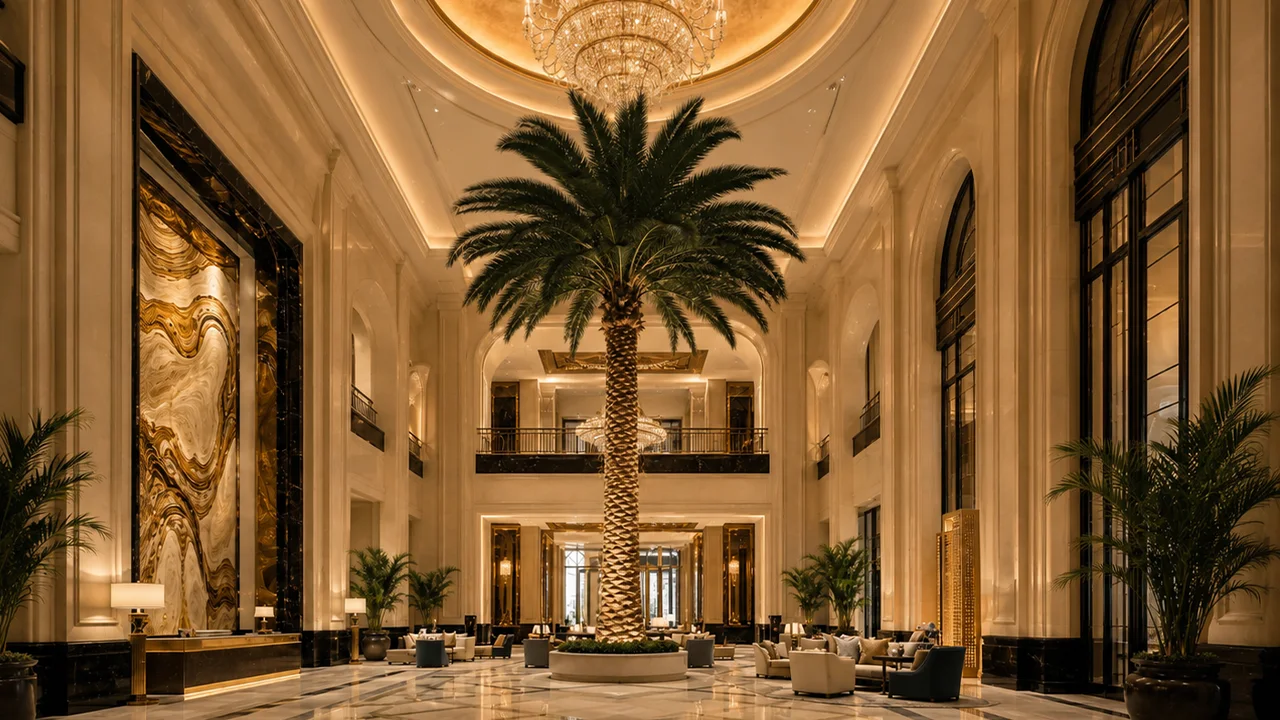
Write those three parameters down before you open a catalogue. They eliminate most of the range for you and turn a subjective browse into a shortlist a colleague could reproduce on the next site.
Match Species To The Interior Style
Different schemes call for different silhouettes. Three reliable workhorses for commercial projects, and what each is actually good at:
| Species form | Reads well in | Why it wins the spec |
|---|---|---|
| Areca / palms | Lounges, corners, resorts | Full layered canopy fills dead space |
| Dracaena / dragon tree | Modern, minimal lobbies | Sculptural upright trunk, clean lines |
| Olive / fig | Mediterranean, boutique | Silver-green or broad leaf, warm character |
Choose species the way you would specify any FF&E item: by how the form behaves in the actual space, and whether the supplier can hold that form consistently when you reorder for phase two.
Read the species choice through traffic and lighting. A sculptural dracaena under a reception downlight shows every mould line, so it earns a higher-detail tooling spec; a full-canopy palm softens a dead corner and forgives lower sightline scrutiny. Matching detail level to sightline is how you avoid paying for realism nobody looks at while under-specifying the one tree every visitor sees first.
Size And Customisation Are The Real Constraints
Commercial ceilings rarely match catalogue heights. Ask whether the supplier can build to size rather than forcing you to compromise. We support OEM/ODM (Original Design Manufacturer) customisation on dimensions, colour and planter, and our trees span the common commercial heights.
For tall floor-standing statements, our KD (knock-down) flat-pack structural design splits into a cement-base planter, a sectioned trunk and bundled foliage that assembles on site in roughly 5-10 minutes with clip connectors. On a 210 cm areca palm, that KD structure cuts shipped volume by about 42.3% and lifts 40HQ container loading by roughly 83.8%—which is why tall trees can be freighted economically at all.
The economics are worth spelling out, because they decide whether a tall statement piece is freight-viable at all. On our 210 cm areca palm, knock-down packing drops a standard carton from about 0.17 CBM to 0.072 CBM and lifts a 40HQ from about 185 to 340 trees. Per-unit ocean cost falls by 40-48% on a full container, container space utilisation climbs from roughly 62% to 94%, and transit damage drops about 60%. Small desktop plants under 60 cm do not justify KD and ship assembled; very large trees and bamboo forms often cannot be knocked down at all.
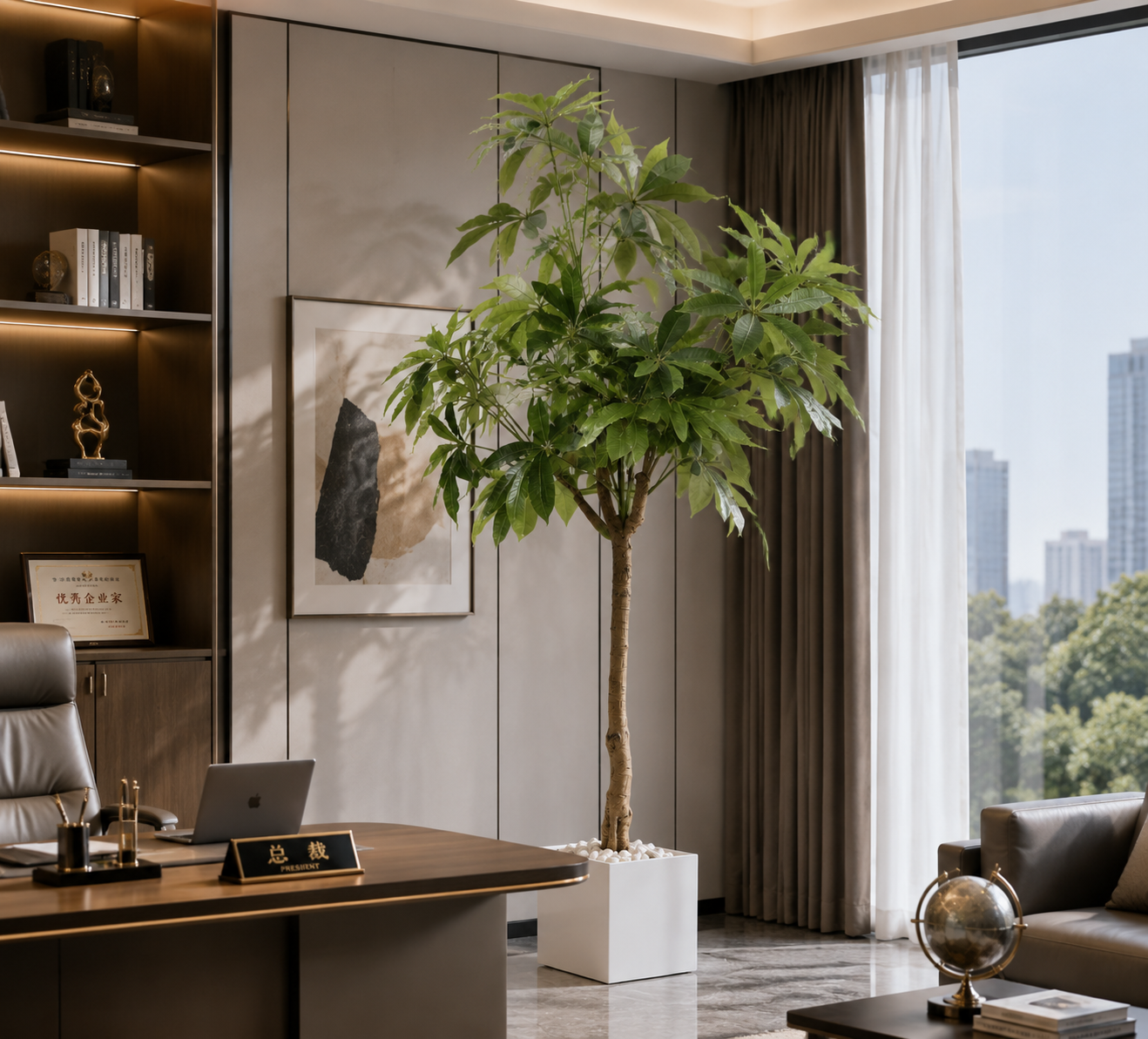
Get the height chart in writing and check it against the room before you commit. A canopy that reads 2.4 m on a spec sheet behaves differently in a 2.6 m lobby with a pendant light in the sightline; and because commercial ceilings rarely match catalogue heights exactly, the supplier who can build to size saves you from a tree that is 15 cm too tall for its own niche.
Prove Fire And Compliance Fit Early
Commercial interiors increasingly carry flame-spread requirements, and a specifier will ask. We can supply fire-retardant materials meeting BS (British Standard) and DIN (German Industrial Standard) requirements as an option—note the wording: we offer compliant materials, we do not claim a certification we have not passed. Where a project needs documentation, confirm the exact standard with the specifier; for US commercial interiors, the relevant flame-spread framework sits with NFPA codes that your local authority applies.
Get the fire standard named in writing before a fire officer questions the scheme. “Fire retardant” means different things under a British Standard BS test, a German DIN test and a US flame-spread classification, and a specifier’s certificate is only as useful as the method behind it. Confirm the exact standard the project requires rather than accepting the label.
Ask which specific lines carry the fire-retardant option and what documentation comes with them, because it is not a blanket property across the catalogue. Pairing a compliant material on the right species with a named test method is what survives a specifier’s review; a general “fire resistant” claim in the brochure does not.
Weigh Total Cost Against A Live Plant
The commercial case for faux in a lobby or mall is maintenance economics, not looks. A live tree needs water, light, rotation, a horticulture contract and periodic replacement when it droops; a quality artificial tree needs none of that. For facility teams the appeal is a green spec that reads identically on every floor and in every branch, with the only recurring task a dust wipe-down on a schedule the site already runs.
That reframes the buying decision. You are not paying for a plant that survives; you are paying for a form that holds its appearance between reorders without a care regime. So the specification priorities shift to what actually degrades: colour-fastness under the site lighting, dust resistance in entry zones, and a base stable enough to survive being knocked in a walkway.
Budget it as a capital item with a multi-year life rather than a consumable. The right question is not “what does one tree cost” but “what does keeping this lobby green for three years cost,” once you net out the horticulture contract, water and replacement plants a live scheme would need. A stable reorder—same species, same height, same colour tolerance—keeps that number flat across every site instead of drifting floor to floor.
One boundary worth stating plainly: we are a product supplier. We give sizing and specification guidance and can advise on species for a given space, but we do not provide commercial-space design, staging or on-site installation. Plan placement and fixing through your local installer or facilities team, and let the supply chain handle what it controls—consistent product at the specified size.
Factor the human cost too. A live scheme needs someone to water, rotate, treat and eventually replace plants on a schedule, and that is staff time a facility team would rather spend elsewhere. A faux spec removes that recurring line item almost entirely, which is why the comparison is rarely about the purchase price of a single tree.
MOQ Lead Time And Reorder Logic
Multi-site rollouts live or die on supply consistency. A practical sequence: pilot one species on one floor at the mixed-order level, confirm it survives real traffic and reads correctly under your lighting, then standardise heights and colours and roll the approved spec out against the schedule. The numbers to confirm in writing before you commit:
- Entry MOQ. A mixed first order from 20 pieces lets you trial a species on a pilot floor before a wider rollout; bulk reorders start from a 100-piece MOQ.
- Lead time. A standard 15-45 day lead time applies across the line—build the project schedule around it and confirm the date.
- Capacity. About 50,000 pieces per month (80,000 in peak) means a large or repeat order is not the bottleneck.
- Reorder consistency. Because tooling, material selection, assembly and packing are in-house, phase-two reorders match the approved spec rather than drifting.
Specify With A Physical Sample
Evaluate a real sample against your lighting and scale before you approve production. We send real leaf and trunk samples so the form you sign off is the form that arrives.
Where To Start The Selection
None of this requires a specialist. The buyers who get commercial greenery right lock space parameters first, prove one species on one floor, and only then standardise and scale. Treat the sample, the tolerance and the reorder as a single decision and the rest follows.
Match species to the space, insist on size customisation and a stable reorder, and keep the schedule realistic against a 15-45 day lead time. Browse the range in our Искусственные деревья & Напольная ботаника category and request a sample set for the species shortlist before you commit volume.
Frequently Asked Questions
Which artificial trees work best in commercial interiors?
Areca palm and other palms for full canopy in lounges and corners; dracaena and dragon tree forms for sculptural lines in modern lobbies; olive and fig silhouettes for Mediterranean and boutique schemes.
Can artificial trees be made to a custom height?
Yes. We support OEM/ODM customisation on dimensions, colour and planter, so a tree can be built to the space rather than forced into a fixed catalogue height.
How do tall floor-standing trees ship?
As KD flat-pack: a cement-base planter, a sectioned trunk and bundled foliage that clip-assemble on site in roughly 5-10 minutes, cutting shipped volume by about 42.3%.
Do you handle installation or styling on site?
No. We are a product supplier. We give sizing and specification advice, but placement and fixing are handled by your local installer or facilities team.
What MOQ and lead time apply to a multi-site order?
A mixed first order from 20 pieces, bulk reorders from a 100-piece MOQ, and a standard 15-45 day lead time, backed by roughly 50,000 pieces of monthly capacity.
Shortlist Species For Your Project
Match form to the space and prove it with a physical sample. Browse the full range and request a sample set for your shortlist before you commit volume.