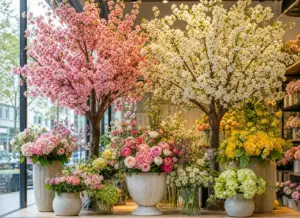
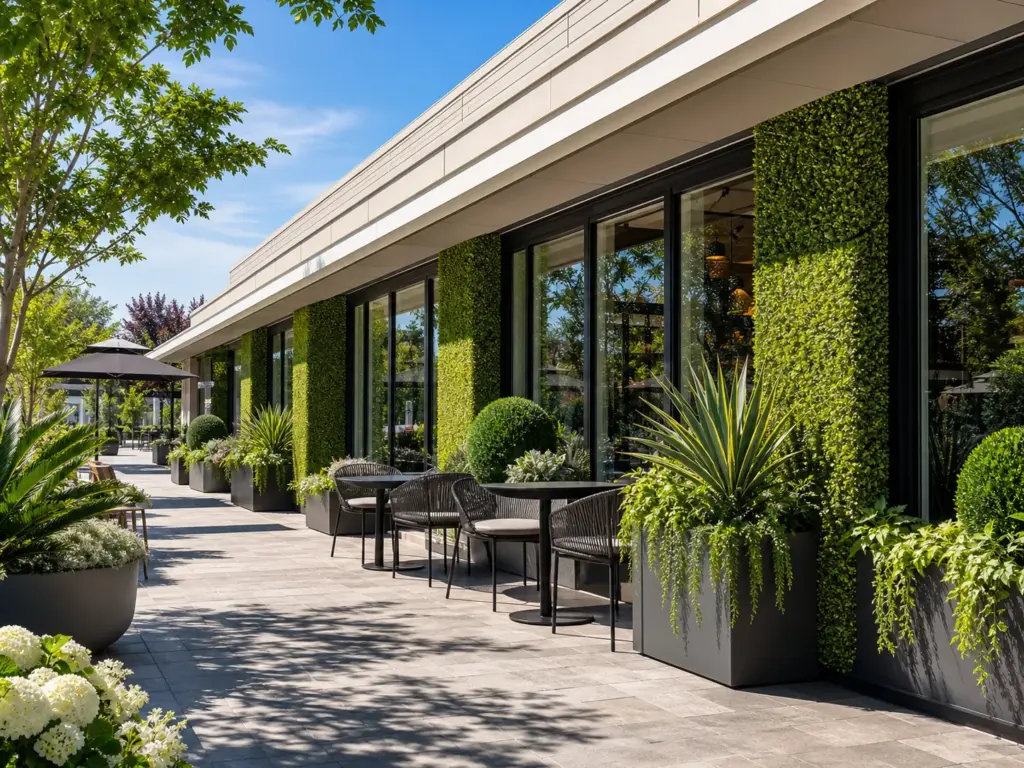
UV resistant artificial flowers are designed for outdoor environments where regular faux flowers may fade, become brittle, or lose their appearance after prolonged sun exposure.
For commercial outdoor displays, hotels, restaurants, landscaping projects, and retail spaces, choosing the right outdoor artificial flowers requires more than checking a supplier’s “UV resistant” label. Buyers should evaluate the materials, weather resistance, testing methods, and supplier capabilities before placing an order.
This guide explains what makes artificial flowers suitable for outdoor use, how UV exposure affects faux floral products, and what to ask suppliers before purchasing outdoor artificial flowers.
Key takeaways
- “UV resistant” is a material question first—ask what makes the product outdoor-suitable.
- Insist on a named test you can stand behind; a claim without a method is marketing.
- We cooperate with UV testing on request; we publish no report or lifespan we lack.
- Sample in the real exposure condition for the window your project allows.
- Entry terms: mixed first order from 20 pieces, bulk MOQ 100, standard 15-45 day lead time.
What Makes Artificial Flowers Suitable For Outdoor Use?
Outdoor artificial flowers face conditions that indoor products do not, including direct sunlight, temperature changes, rain, humidity, and dust.
The main difference between indoor and outdoor faux flowers is the material performance.
Three factors usually affect outdoor durability:
UV-Stable Materials
Ultraviolet radiation can break down pigments and polymers through photodegradation. Over time, this may cause colour fading, surface cracking, or reduced flexibility.
Outdoor artificial flowers often use materials and colourants selected to improve resistance against UV exposure.
Weather-Resistant Construction
Outdoor performance depends on more than the flower petals. The complete structure matters, including:
- flower head material
- leaf material
- internal wire
- stem coating
- connection points
A strong flower head with a weak stem coating may still fail when exposed to outdoor conditions.
Suitable Surface Finish
Outdoor floral displays collect dust, pollen, and environmental particles. A smoother surface finish makes cleaning easier and helps maintain the appearance of the installation.
For this reason, buyers should evaluate the complete product construction rather than focusing only on appearance.
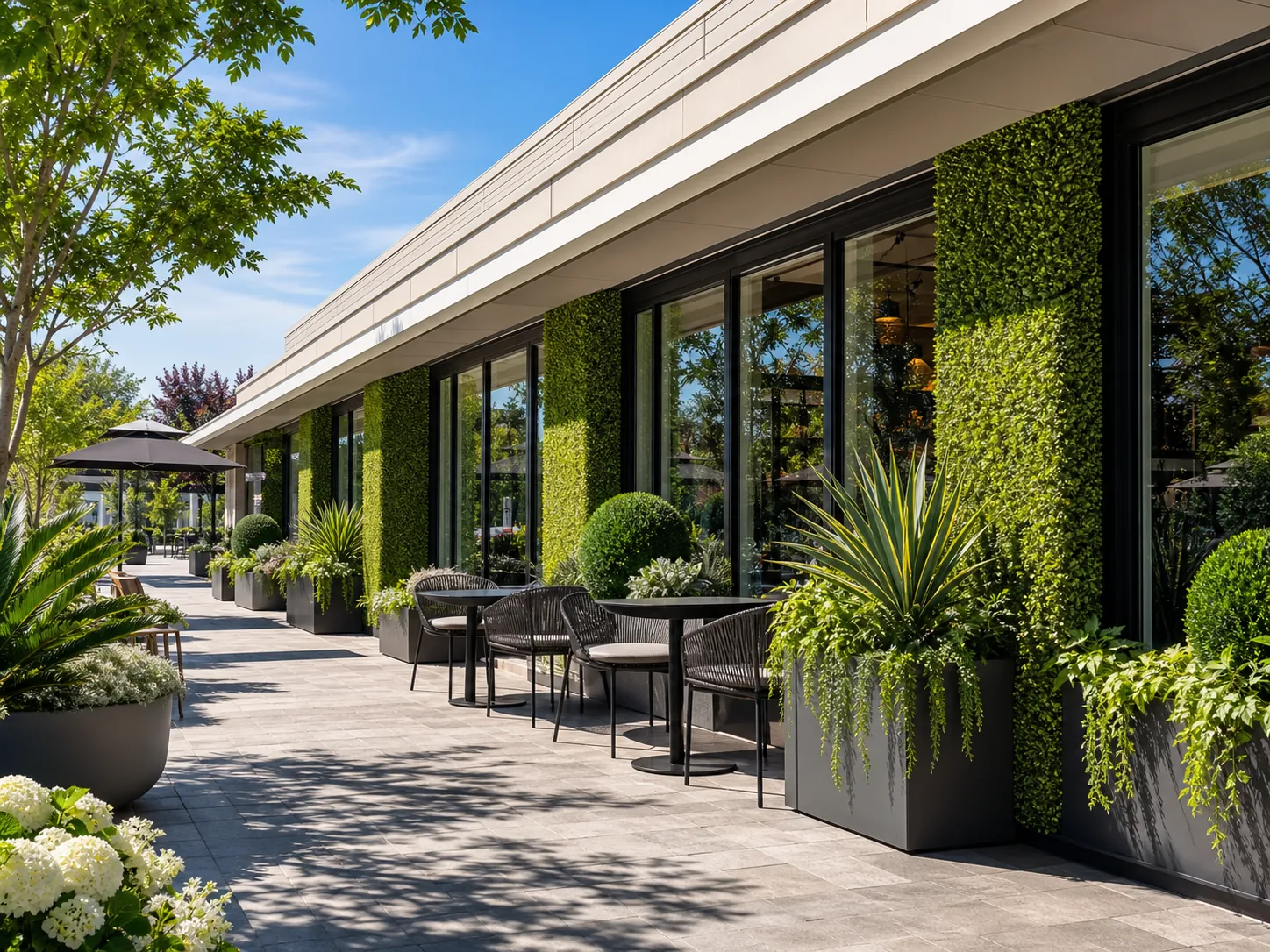
How Does UV Exposure Damage Artificial Flowers?
Outdoor failure has a short, knowable list of causes. Naming them turns a vague “will this last outside” into specific questions you can put to a supplier and test on a sample:
| Failure mode | Root cause | What to specify |
|---|---|---|
| Colour fade | UV breaks down pigments | UV-stable colourants; fade band |
| Brittle stems | Polymer embrittlement | Exterior-rated wire and polymer |
| Warping | Heat plus direct sun | Heat-tolerant material, shaded mount |
| Dust build-up | Rough surface holds grit | Smooth, wash-down finish |
| Faded one season | Indoor stock resold outdoor | Named weathering test |
Each row maps to a question. Ask which components are rated for exterior use, not whether the display looks outdoor-ready—heads, wire and stems weather at different rates, and a single indoor-grade part in the assembly fails first and makes the whole piece look cheap.
The Honest Position On Testing
This is where buyers should apply scrutiny. A “UV resistant” label means little without a named method behind it. Specify the test, then confirm the supplier can support it. For accelerated weathering, the recognised framework is a xenon-arc or UV-weathering protocol (the ASTM G154 family is the common reference buyers ask for). Our stance: our outdoor line is produced for exterior use and we can cooperate with UV-resistance testing on request; we do not publish a report we do not hold or a durability lifespan we cannot evidence.
If a supplier quotes a five-year outdoor warranty with no test method behind it, that number is a marketing figure, not a specification.
A reasonable ask in plain terms: name the weathering method, state which components are covered, and give a result you can photograph against. Accelerated-aging reports (xenon-arc or UV-fluorescent protocols) are the common evidence buyers cite; a supplier who cannot discuss methods at all is telling you the “UV resistant” line is decorative. We would rather cooperate on a test you specify than assert a number we cannot back.
What To Specify For An Outdoor Program
- Intended exposure. Full sun, coastal salt, or a covered patio changes the material and the test you should ask for.
- Colour-fastness expectation. Agree how much fade is acceptable and on what basis it will be assessed.
- Component durability. Stems, wire and heads weather differently; ask which parts are rated for exterior use.
- Cleaning and maintenance. Outdoor pieces need a wash-down regime; confirm the material tolerates it.
Write the exposure condition into the order, not the assumption. “Outdoor” means different things for a full-sun terrace, a covered entry and a coastal façade; salt, heat and direct UV each attack the material differently. The more precisely the installation is described, the more usefully a supplier can point to the right grade and the right test.
Do not forget the maintenance reality that decides long-term appearance. Outdoor floral collects dust, pollen and grit, and a piece that cannot be hosed down or wiped will look tired well before the material actually fails. Confirm the finish tolerates washing without shedding leaves or loosening heads—this is a specification point, not an afterthought, and it is the difference between a five-season display and a two-season one.
Pair UV-capable floral with the wider Outdoor UV-Resistant range where an installation mixes flowers with foliage or trees.
MOQ Customisation And Lead Time
Outdoor floral is usually specified per project, so flexibility matters more than depth. We support a mixed first order from 20 pieces and bulk reorder from a 100-piece MOQ, with OEM/ODM customisation on size, colour and planter or packing. Standard lead time is 15-45 days across the line, with monthly capacity around 50,000 pieces (up to 80,000 in peak), so a seasonal exterior refresh or a multi-site hospitality rollout can be scheduled without a supply squeeze.
Timing is part of the specification for exterior work. A hospitality patio refresh or a retail frontage change usually has a fixed date, so confirm the lead time against that window and, if the season is tight, split the order: a first mixed batch to prove the grade in real exposure, then the volume order once the sample has held. That keeps a single supplier delay from stranding an installed look.
Customisation is where an outdoor program gets its identity without its risk. OEM/ODM on size, colour and the planter or fixing lets you match a façade or a branding scheme, but keep the customisation inside the grades you have proven outdoors. A new colour on a tested UV-stable base is a sensible extension; a bespoke colour nobody has exposed is a fresh experiment hiding inside a volume order, so sample it as if it were new.
Sample In Real Exposure Before Volume
Never approve an outdoor volume on a catalogue image. Request a physical sample, place it in the real exposure condition, and observe it over the window your project allows. We send real samples so you judge colour and material behaviour yourself rather than trusting a claim. Agree the acceptable colour tolerance in writing at the same time—some variation is normal in faux florals, and settling it before production avoids disputes on delivery.
Judge the sample where it will live, not on your desk. A covered-patio sample evaluated under office lighting tells you little about how the same piece behaves in reflected sun and wind-driven dust. If the project allows, expose two samples to two conditions and compare them at the review date—fading and brittleness are relative, and a control makes the difference visible.
Keep the exposure test honest about season. A sample that only spent the mild months abroad has been decorated, not tested. If your window allows, leave the trial piece through the hardest conditions the real site will see—peak summer sun, a coastal wind, a frost if the location gets one—and photograph it at set intervals. That record is worth more than any warranty sentence, and it is the one artefact both sides can point to if a later container looks off.
What We Do Not Claim
To keep the specification honest: we do not present certifications we have not passed, we do not publish an outdoor lifespan figure we cannot support, and—as a product supplier—we do not provide outdoor design, staging or installation. Your placement and fixing are handled locally; we supply the product, sizing and specification guidance.
This is not false modesty—it is where buyers get protected. A supplier willing to say what they have not tested, and what they do not install, is easier to hold accountable than one who promises a lifespan and disappears when it fades. Take the boundary as a signal: the same candour that limits the claim is what makes the delivery terms trustworthy.
Saying this out loud protects both sides. If the specification is built on a named test and a real-exposure sample rather than a printed warranty, a disagreement later is about evidence, not promises—and evidence is something a product supplier and a procurement buyer can both check against the sample and the photographs. That is a far better basis for a repeat outdoor order than a durability number neither of us can actually verify, and it is the reason we would rather earn the reorder than claim it upfront.
Test The Claim, Not The Label
Specify the UV test you need and confirm the supplier can support it before you order. We send real samples for your own exposure trial.
Frequently Asked Questions
Are artificial flowers really UV resistant for outdoors?
It depends on the material, not the label. Ask what makes the product outdoor-suitable and specify a named weathering test; a supplier who controls their own formulation can answer, a reseller usually cannot.
Do you provide a UV test report?
We can cooperate with UV-resistance testing on request, but we do not publish a test report we do not hold, and we state no outdoor lifespan figure we cannot evidence.
What should I specify for an outdoor floral program?
Intended exposure, an acceptable colour-fastness band, which components are rated for exterior use, and a cleaning regime the material tolerates.
Can outdoor floral be customised?
Yes—OEM/ODM on size, colour and planter or packing, with a mixed first order from 20 pieces and bulk reorder from a 100-piece MOQ.
Do you install outdoor displays?
No. We supply product and specification guidance; outdoor design, staging and fixing are handled by your local team.
Specify Outdoor Floral On Evidence
Ask what makes the product outdoor-suitable, insist on a test you can stand behind, and sample in real exposure before you commit volume.