
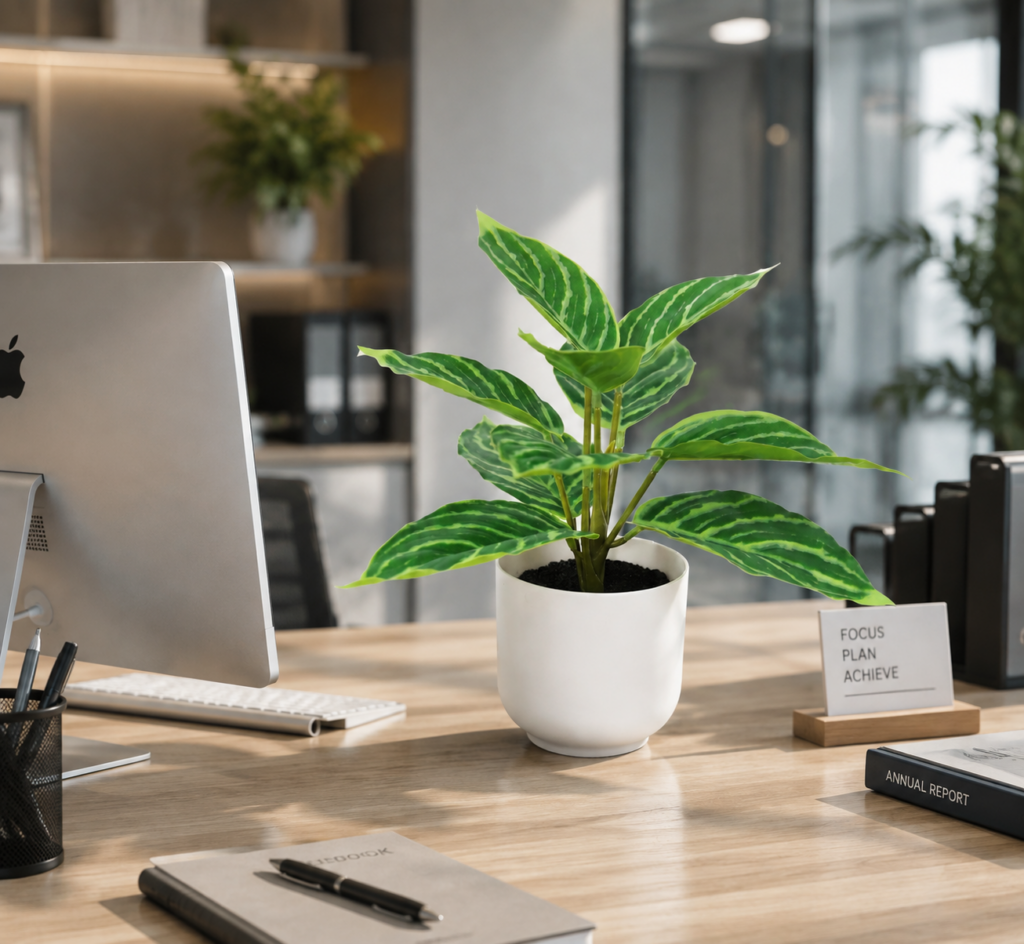
Artificial potted plants for outdoors carry the entrances, patios and retail fronts that larger trees cannot reach, and outdoors they are the first thing weather tests. Sun, rain and wind each attack a different part of the product—foliage colour, planter construction and base stability—so an outdoor potted order is judged on three checks: UV material, drainage and weighting. This guide walks them in the order a buyer needs them.
Grand Green supplies artificial potted plants across monstera, snake plant, fern, succulent and mixed-foliage lines, alongside a dedicated outdoor UV-resistant series. The same factory terms apply across the range: a mixed first order from 20 pieces, bulk reorders from a 100-piece MOQ, and a standard 15-45 day lead time.
Key takeaways
- Three checks decide an outdoor potted order: UV material, planter drainage, base weighting.
- UV position stated plainly: no test report on hand, testing cooperation available where documentation is required.
- Standing water is the quiet killer—planter drainage and placement off wet ground belong in the spec.
- Weighting and footprint should match plant height and the wind the position actually gets.
- Most potted plants under 60 cm ship fully assembled—no on-site assembly step.
What Outdoors Demands of A Potted Plant
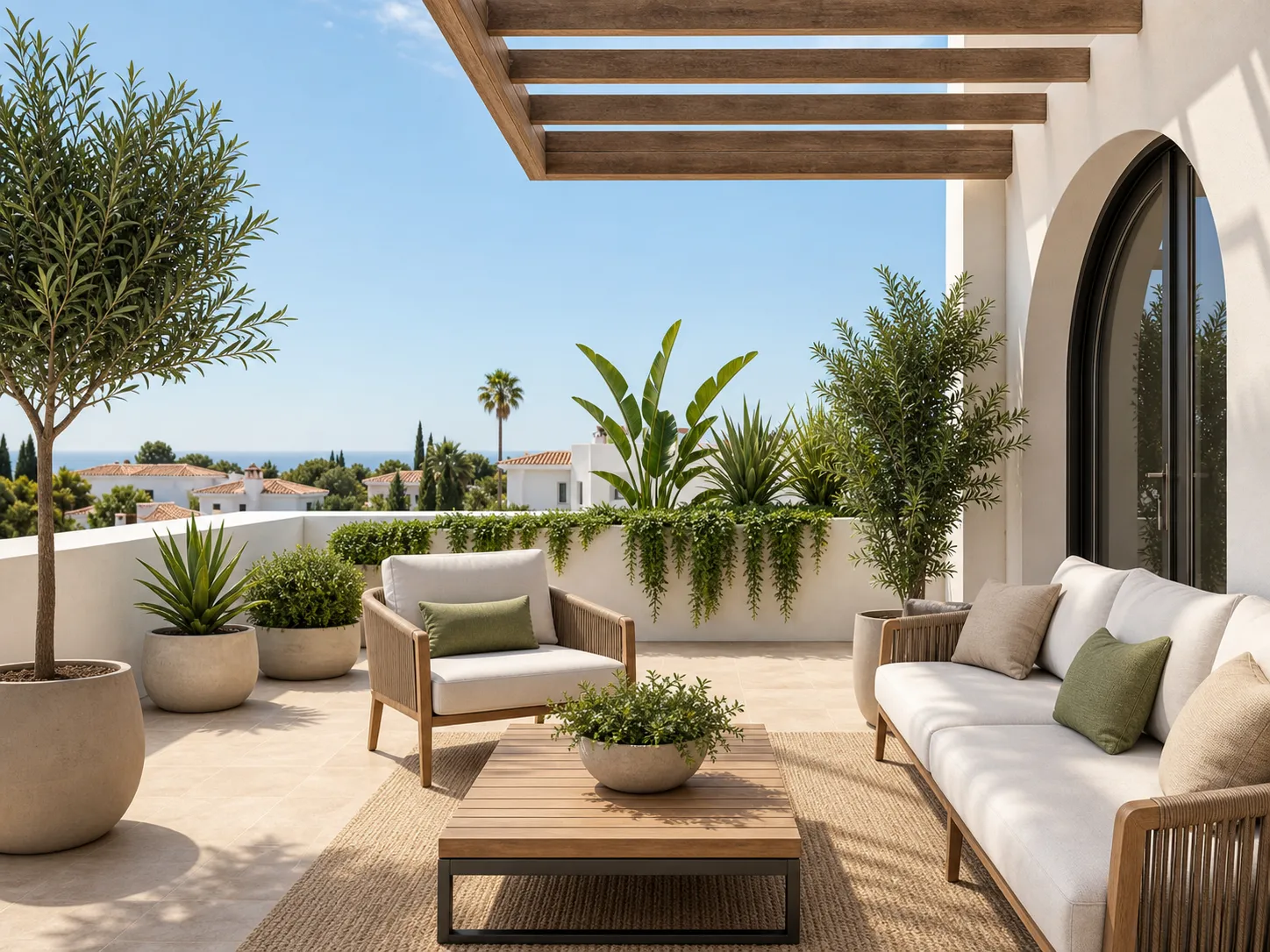
Indoor potted plants fail politely; outdoor ones fail in the rain. Four forces set the spec. Sunlight fades foliage and degrades finishes, and potted plants sit at eye level where the change shows fastest. Rain pools in planters that cannot drain, which stains, smells and eventually shifts the planting media. Wind tips top-heavy pots on exposed terraces. Heat radiates from paving and walls, which is hardest on the parts nearest the ground.
None of these are exotic problems—each has a spec answer. The three checks below cover them in the order that matters when you enquire.
The UV Check Done Properly
Start with the foliage, because that is what shoppers see. The outdoor UV-resistant series uses UV-stabilised material options for exterior positions, and the position on testing is stated plainly: Grand Green holds no UV test report today, but testing cooperation is available for projects that require documentation. Say what the site gets—full sun, partial shade, reflected heat off paving—because exposure level changes the material answer.
Apply the same standard to every supplier quote. Ask which material the foliage uses, what exposure it is intended for, and what testing supports the claim. A UV label without a method behind it is a return waiting to happen.
Drainage Before Delivery Day
Drainage is the check most orders skip and most sites regret. A planter that cannot shed rain collects standing water, which marks the pot, carries planting media out over the paving and freezes solid in cold climates. Before ordering, confirm in writing how the planters handle water: what drain provisions exist, where they sit, and what the planter interior is made of.
Placement is the other half of drainage. Pots raised on pot feet or paving edges shed water cleanly; pots set flush on soil or turf sit in a puddle after every storm. Your landscape plan decides the placement—the product spec has to support it, which is why the drainage question belongs in the enquiry, not after delivery.
Written down, the drainage check covers five questions:
- Do the planters have drain provisions, and where do they sit?
- What is the planter interior made of, and does it hold up to wet media?
- In cold markets, does the planter survive a freeze with water in it?
- Will the position let water escape—raised on feet or edges, or flush on soil?
- What happens to the surface beneath the pot after a storm?
A supplier who answers those five without hesitating has actually thought about outdoor use. The answers also belong in the receiving standard, so the team checking the container verifies the same provisions that were quoted.
What The Planter Is Made Of
Foliage gets the attention, but the planter does the surviving. Confirm the planter material and finish before ordering: how it handles standing water, how it behaves across a freeze-thaw winter in cold markets, and how its colour sits against the foliage it holds—a warm-tone pot under cold-green leaves reads assembled rather than designed.
Planter options are part of the OEM/ODM scope along with dimensions, colour and packaging, so the pot can be specified to the scheme rather than matched afterwards. For commercial runs, keep the planter spec on the reorder document—a rollout of matching plants in mismatched pots shows across the whole site.
Weighting And Wind Stability
The stability check is a ratio: planter weight and footprint against plant height and canopy. A tall snake plant in a narrow pot is a lever waiting for a gust; a low, broad fern in a wide planter barely moves. Confirm base weight and dimensions with the height chart, and match them to the wind the position actually gets—an entrance with overhead shelter needs far less than an open rooftop.
Where a position needs more, OEM/ODM covers planter size and weight, so the base can be specified instead of improvised with ballast on site. For most commercial positions the engineered weight is enough; for exposed ones, spec it up front.
One practical note on assembly: most potted plants under 60 cm ship fully assembled, so there is no build step on site—unpack, place, done. Larger structures follow the KD module logic used across the tree range where the design allows it.
Species That Earn Their Outdoor Spot
Not every indoor plant reads right outdoors. The lines that earn exterior positions are the structural ones: snake plants for vertical accent, ferns for shaded fill, succulents for low and wide planters, and monstera for the tropical reading hospitality schemes want. Match species to exposure—ferns and lush foliage read best in shade, succulents and structural plants take the sun end.
Mix heights in the same scheme. Entrance pots at 100-120 cm anchor the door, mid-height planting fills the middle, and low succulent bowls finish edges and steps—one order, mixed SKUs, one container position.
From Indoor Lines To Outdoor Positions
Buyers regularly ask if an indoor line can move outside. The honest answer is that exposure decides, not the plant name: an indoor monstera and an outdoor-grade monstera are the same silhouette built to different material and finish specifications. Moving an indoor SKU to a patio puts UV fade and water exposure on a product that was never specified for either.
The practical route is to keep the silhouette and change the spec. The outdoor UV-resistant series carries the same reads—tropical foliage, structural plants, potted forms—with exterior materials and finishes, so a scheme can hold its look inside and out without asking an indoor product to do an outdoor job. Specify by position, and the line-up stays honest on both sides of the glass.
Maintenance That Keeps The Look
Outdoor potted plants need less attention than live ones and more than indoor faux. The routine is short: wash dust and pollen off the foliage on a schedule the site already runs, clear drain paths after storm season, and reseat pots that have shifted on their surface. None of it requires training, and all of it protects the colour and structure the order was specified for.
Seasonal schemes can go further—rotate summer and winter planting between positions and store the set that is out of use under cover. With that care the products are reusable season after season, which is the practical argument for specifying quality planters and UV materials in the first place.
A Site Survey In Four Photos
The fastest way to get the right specification is to show the supplier the position. Photograph four things and attach them to the enquiry: the position in morning sun, the same position in afternoon sun, the surface and surrounding finishes, and the clearance around and above the spot.
Those photos tell a supplier most of the spec—exposure direction and intensity, the wind the position actually gets, the surfaces the pot and base work with, and the scale the planting has to hold. For artificial potted plants for outdoors, that is the difference between a catalogue guess and a specified order.
Order Terms And Sample Checks
Terms match the rest of the range: mixed first order from 20 pieces, bulk reorders from 100, T/T 50/50 on first orders, EXW, FOB and CIF freight terms, and 15-45 days standard lead time. Samples can go by air when a decision is waiting.
Check the sample the way the site will use it. Put it in real sun and real rain, fill the planter with water and watch it clear, push the pot from the side and see when it tips. Photograph each result—those photos become the receiving standard, and transit damage on production orders is photographed on receipt and reshipped.
Two after-sales lines belong in the same email: transit damage on a visible plant or planter is photographed on receipt and reshipped, and consumable parts such as the base or planter are compensated or over-shipped on the next order. Agreeing them up front keeps the first damaged carton a logistics event rather than an argument.
Browse the options in our 屋外耐紫外線性 range, and confirm drainage and weighting in writing with the sample order.
よくある質問
Will artificial potted plants fade outdoors?
The outdoor UV-resistant series uses UV-stabilised material options. No UV test report is held today; testing cooperation is available for projects that require documentation.
Do planters for outdoor artificial plants need drainage?
Confirm drain provisions in writing before ordering. Standing water stains planters, shifts planting media and freezes in cold climates, and placement on wet ground makes it worse.
How do I keep outdoor potted plants stable in wind?
Match base weight and footprint to plant height and the position’s real wind; OEM/ODM can specify heavier or larger planters where a site needs them.
What sizes ship fully assembled?
Most potted plants under 60 cm ship assembled—unpack and place. Larger structures follow the KD module logic where the design allows.
What are the MOQ and lead time for an outdoor potted order?
A mixed first order from 20 pieces, bulk reorders from a 100-piece MOQ, and a standard 15-45 day lead time.
Spec The Pot Before The Plant
Send the site exposure and wind conditions, and request the UV material options, planter drainage details and base weights with your sample set.


